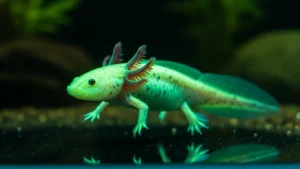
Will Axolotls Eat My Fish?

Yes, axolotls will absolutely eat fish if given the opportunity. Axolotls are carnivorous predators that view small fish as natural prey items. Any fish small enough to fit in an axolotl’s mouth typically anything under 3-4 inches will eventually be hunted and consumed. Even larger fish aren’t entirely safe, as axolotls may bite at fins, tails, or bodies, causing injuries. Additionally, most fish have incompatible temperature requirements with axolotls, making cohabitation problematic even when predation isn’t an immediate concern. Housing axolotls with fish is generally not recommended.

Understanding Axolotl Predatory Behavior
Axolotls are natural-born hunters with strong predatory instincts hardwired into their biology. In their native Mexican lake habitat, their diet consists primarily of aquatic insects, worms, small crustaceans, and small fish. This carnivorous nature doesn’t disappear in aquarium settings axolotls will hunt anything that moves and appears edible.
Their hunting technique relies on detecting movement and vibrations in the water rather than visual acuity, since axolotls have relatively poor eyesight. When a fish swims nearby, the axolotl senses the motion and responds with a rapid strike, opening its wide mouth to create suction that pulls prey inside. This feeding response is instinctual and occurs even when the axolotl has been recently fed.
Fish size matters significantly. Small fish like guppies, neon tetras, minnows, or baby goldfish are immediate targets that will be consumed quickly often within hours or days of being introduced to an axolotl tank. Medium-sized fish (2-4 inches) may survive longer due to swimming speed, but they remain at constant risk, creating chronic stress for both the fish (from being hunted) and the axolotl (from the ongoing stimulation of its prey drive).
Even larger fish that are theoretically too big to swallow whole aren’t completely safe. Axolotls may still bite at flowing fins, tails, or slow-moving fish during nighttime feeding hours when axolotls are most active. These attacks cause injuries that can lead to infection or stress-related diseases in the fish.
Temperature and Environmental Incompatibility
Beyond predation, temperature requirements create a fundamental barrier to successfully housing axolotls with most aquarium fish. Axolotls are cold-water amphibians requiring temperatures between 60-64°F (16-18°C). Most popular aquarium fish are tropical species needing 72-82°F (22-28°C). This 10-20 degree gap makes it impossible to create suitable conditions for both.
The few fish species that tolerate cooler water such as white cloud minnows, certain goldfish varieties, or rosy red minnows still face predation risk from axolotls. White cloud minnows, despite preferring cooler temperatures, are small enough (1.5 inches) to be eaten. Goldfish, while potentially too large when fully grown, produce excessive waste that compromises water quality and may nip at axolotl gills.
Another concern involves fish behavior affecting axolotls. Fast-moving, curious fish may investigate and nip at an axolotl’s feathery external gills, causing stress and potential damage to these vital respiratory organs. Even non-aggressive fish create constant movement that keeps the axolotl in a heightened hunting state, preventing proper rest and causing chronic stress.
Fish also introduce disease risks. Many fish carry parasites or bacterial infections that can transfer to axolotls. Live fish used as feeders are particularly risky, potentially introducing ich, fin rot, or internal parasites into the axolotl’s system.
Quick FAQ
What size fish are safe from axolotls?
No fish is truly safe. While fish over 4-5 inches may be too large to swallow, axolotls can still bite and injure them, and temperature incompatibilities remain problematic.
Can I feed fish to my axolotl?
Live feeder fish aren’t recommended as a staple diet due to disease risk and poor nutritional balance. Occasional small fish treats are acceptable, but earthworms and pellets are healthier options.
Will fast fish like danios escape being eaten?
Initially, yes, but axolotls are patient hunters. Fast fish may evade capture temporarily, but eventually they’ll be caught, especially during nighttime or when the fish is resting.
What about bottom dwelling fish like corydoras?
Bottom dwellers share the axolotl’s territory, making encounters more frequent. Most corydoras species also require warmer water than axolotls can tolerate safely.
Are there ANY fish compatible with axolotls?
Realistically, no. While some aquarists report temporary success with cold-water species like white cloud minnows, long-term compatibility is rare and the axolotl usually prevails as the predator eventually.
Administrator
Abdul Wasay is the founder and lead author of Axolotl Portal, a trusted site for axolotl care. He spent almost nine months learning about axolotls, including their tanks, feeding, water care, and common health problems. His knowledge comes from trusted vets, research, and real experience from long term axolotl owners. All Posts by
Related Guides
Do Axolotls Need Live Plants?
Abdul Wasay Khatri
Can Axolotls Have Rocks in Their Tank?
Abdul Wasay Khatri
How Big Do Axolotls Get? Growth Timeline & Size Guide
Abdul Wasay Khatri
What Are Good Axolotl Names? 100+ Ideas That Actually Fit These Weird Little Creatures
Abdul Wasay Khatri

What Do Axolotls Eat? Complete Feeding Guide (2026 Update)
Abdul Wasay Khatri
The Complete Axolotl Tank Setup Guide: Everything Your Water Dragon Needs
Abdul Wasay Khatri
Do Axolotls Need a Bubbler?
Abdul Wasay Khatri
What Size Tank Does an Axolotl Need?
Abdul Wasay Khatri
Male vs Female Axolotl: Which Is Better? The Complete Comparison
Abdul Wasay Khatri
What Are GFP Axolotls? The Complete Guide to Glow-in-the-Dark Water Creatures
Abdul Wasay Khatri