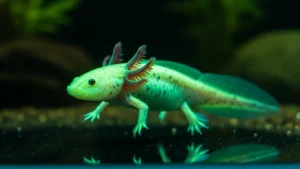
Why Can Axolotls Regenerate But Humans Can’t?

Direct Answer
Axolotls can regenerate because their cells keep the ability to turn back into stem cells and rebuild tissue throughout their entire life. Humans lose this ability after we’re born our cells form scar tissue instead of regrowing lost parts. Axolotls also don’t have the same immune response that stops regeneration in mammals. Their bodies treat injuries as something to rebuild, while our bodies just patch the hole and move on.

How Their Cells Work Differently
When an axolotl loses a leg, cells near the wound reverse back to a stem cell-like state. These cells forget what they used to be (skin, muscle, bone) and become flexible again. They form a blob called a blastema that knows how to rebuild whatever’s missing. Human cells can’t do this once a muscle cell becomes a muscle cell, it stays that way forever.
Axolotls have special genes turned “on” that humans have turned “off.” We actually have the same regeneration genes they do, but ours shut down after early development. Scientists found that human embryos can regenerate in the womb up to about 8 weeks, but then our bodies flip the switch and we lose it. Axolotls never flip that switch they stay in a permanent regeneration-ready state.
Their immune system works differently too. When humans get injured, our immune cells rush in and tell the body to seal everything up fast with scar tissue. This prevents infection but also prevents regrowth. Axolotls have a much calmer immune response that allows stem cells time to organize and rebuild properly instead of just forming a scar.
What Scientists Are Learning
Researchers are studying axolotls to figure out how to turn human regeneration back on. The big challenge is that scar tissue formation in humans happens automatically it’s built into how we heal. To regenerate like axolotls, we’d need to suppress scarring without causing infections or other problems.
Some progress has been made with fingertips. Young kids can sometimes regrow fingertip tissue if the wound is treated right and doesn’t scar over. This shows humans haven’t completely lost regeneration ability, we’ve just buried it under other healing processes that evolution favored.
The size difference matters too. Axolotls are cold-blooded and have slower metabolisms than warm-blooded humans. This gives their cells more time to organize regeneration before the body demands the wound be closed. Humans need fast healing to survive, so we evolved speed over perfection.
FAQ
Do any other animals regenerate like axolotls?
Yes, salamanders in general can regenerate, plus some lizards regrow tails, starfish regrow arms, and planarian worms can regrow their entire body from a tiny piece. Mammals are the worst at regeneration deer can regrow antlers and that’s about it.
Could humans ever regenerate limbs like axolotls?
Maybe someday, but we’re decades away from that. Scientists would need to figure out how to reactivate dormant regeneration genes, prevent scar tissue, and control the regrowth process. Lab mice have regrown fingertips in experiments, so it’s not impossible.
Why did humans evolve to lose regeneration?
Regeneration is slow and uses tons of energy. Humans evolved to prioritize fast healing that prevents infection and blood loss. Scar tissue closes wounds in days, while regeneration takes months. Our survival strategy favored speed over perfection.
Can axolotls teach us to regrow human organs?
That’s what researchers hope. Axolotls can regrow heart tissue and parts of their brain, which could lead to treatments for heart attacks and brain injuries. But human organs are way more complex, so don’t expect miracle cures anytime soon.
If we have the same genes, why can’t we just turn them on?
It’s not that simple. Genes don’t work alone they’re part of huge networks that control each other. Turning on regeneration genes might also turn on cancer genes or cause other problems. Scientists need to understand the whole system before messing with it.
Administrator
Abdul Wasay is the founder and lead author of Axolotl Portal, a trusted site for axolotl care. He spent almost nine months learning about axolotls, including their tanks, feeding, water care, and common health problems. His knowledge comes from trusted vets, research, and real experience from long term axolotl owners. All Posts by
Related Guides
How Many Chromosomes Do Axolotls Have? Complete Genetics Guide
Abdul Wasay Khatri
What Body Parts Can Axolotls Regenerate?
Abdul Wasay Khatri
Can Axolotls Regrow Their Brain or Internal Organs?
Abdul Wasay Khatri
Can Axolotls Feel Pain? Understanding Their Sensory Experience
Abdul Wasay Khatri
Are Axolotls Actually Immortal? Separating Myth from Reality
Abdul Wasay Khatri
How Do Axolotls Breathe? Three Amazing Methods Explained
Abdul Wasay Khatri
Can Axolotls Become Salamanders? The Truth About Metamorphosis
Abdul Wasay Khatri
How Long Does It Take for an Axolotl to Regrow a Limb?
Abdul Wasay Khatri
Axolotl Skeleton Explained – Amazing Bone Facts You Should Know
Abdul Wasay Khatri
Axolotl Morphing Signs: What to Watch For
Abdul Wasay Khatri