
How Many Axolotls Are Left? The Shocking Numbers

Your pet store has 20 axolotls for sale. Your friend just bought one online. TikTok is flooded with axolotl videos. They seem to be everywhere.
But here’s the reality that’ll shock you: wild axolotls are nearly extinct.
The Numbers That Tell Two Different Stories

In the Wild: Critically Endangered
50 to 1,000 axolotls remain in their natural habitat.
Some recent reports suggest the number may be even lower fewer than 100 mature individuals.
That’s it. In the entire world, wild axolotls exist in one tiny location: the canal systems of Lake Xochimilco in Mexico City. Their other natural home, Lake Chalco, was completely drained by the government.
In Captivity: Thriving
1 million axolotls live in captivity worldwide.
Pet stores, research labs, homes, and breeding facilities keep the species alive outside their natural environment. These captive populations are healthy, reproducing, and growing.
The Wild vs Captivity Paradox
This creates one of the strangest conservation situations on Earth:
Wild population: Collapsing toward zero
Captive population: Exploding into the millions
You can walk into a pet store and buy an axolotl for less than the cost of dinner. Meanwhile, scientists desperately search the canals of Mexico City and struggle to find even a handful of wild ones.
Think about that. A species with over a million individuals is still critically endangered because almost none live where they’re supposed to.
Why Wild Numbers Are So Low
The wild axolotl habitat has become a nightmare.
Mexico City Expansion
The high-altitude lakes around Mexico City that axolotls once inhabited have been decimated by habitat degradation. What was once a system of interconnected lakes is now a series of small, polluted canals.
The city grew. The lakes shrank. Simple as that.
Water Pollution
Agricultural and industrial pollution have drastically reduced the axolotl population. Urban runoff, untreated sewage, and chemical contamination make the remaining canals barely livable.
Invasive Fish Species
The introduction of tilapia and other invasive fish species eat baby axolotls and compete with adults for food.
These fish weren’t there before. Humans introduced them for food production. Now they’re destroying the ecosystem that wild axolotls need.
The Timeline of Collapse
In 1998, the population was estimated at 6,000 individuals per square kilometer. By 2014, that had plummeted to just 36 individuals per square kilometer.
That’s a 99% decline in 16 years.
The 2025 Extinction Warning
A study by the National Autonomous University of Mexico warned that wild axolotls might vanish by 2025.
We’re in 2026 now. They’re not completely gone yet, but they’re hanging on by a thread.
Current estimates suggest fewer than 1,000 remain in the wild. Some surveys find even fewer. The extinction timeline wasn’t wrong it was optimistic.
Why Scientists Can’t Get Exact Numbers
You’d think with so few left, we could count them precisely. We can’t.
Axolotls are extremely shy of humans. Even experienced conservationists have a difficult time finding them in the wild.
They hide. They’re small. The water is murky. The canals are complex. Trying to count every axolotl in the remaining habitat is like trying to count every specific minnow in a muddy pond.
The range of 50-1,000 exists because scientists genuinely don’t know. The actual number could be anywhere in that spectrum.
The Captivity Success Story
While wild populations collapse, captivity tells a completely different story.
How Captive Numbers Grew
Axolotls were first brought to Europe in 1864. Scientists loved them for research. Europeans across the continent began breeding them, which began a robust pet trade in the animals that breed easily in captivity.
Breeding axolotls is simple:
- They reach maturity at one year
- Females lay up to 1,000 eggs at once
- Babies survive well in controlled environments
- Multiple generations per year are possible
Do the math. Start with 10 axolotls. Within a few years, you have thousands.
Where Captive Axolotls Live
Research laboratories: Thousands of axolotls serve in scientific studies worldwide, especially regeneration research.
Pet trade: Hundreds of thousands live in home aquariums across America, Europe, Asia, and beyond.
Breeding facilities: Commercial breeders maintain large populations specifically for selling to pet stores and individuals.
Educational institutions: Schools, universities, and museums keep axolotls for teaching purposes.
The Color Difference
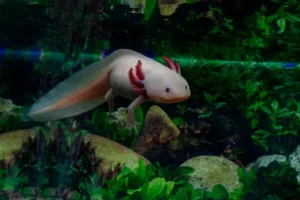
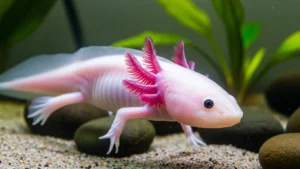
Wild axolotls are brown or olive with dark spots perfect camouflage. In the wild, they’re mostly grayish-brown in color. Lighter colored specimens, especially those with white bodies and pink gills, are usually bred as pets.
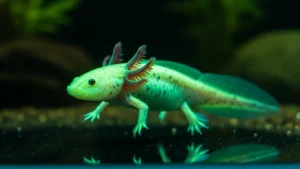
Every pink, golden, white, or black axolotl you see is a product of captive breeding. These colors would never survive in the wild predators would spot them instantly.
The Conservation Efforts
Scientists aren’t giving up on wild populations.
Habitat Restoration
Researchers are working on multiplying the number of restored chinampas (traditional canals) in Lake Xochimilco. These restored areas provide cleaner water and better conditions.
Captive Breeding for Release
A 2025 study confirmed the viability of releasing captive-bred axolotls into the wild, with recaptured animals putting on weight compared to their release weight.
This proves captive-bred axolotls CAN survive in restored wild habitats. The problem isn’t the axolotls it’s the habitat quality.
The Challenge
Reintroduction is really a plan B. The team’s first goal is to improve habitat conditions for axolotls already living in the wild.
Releasing more axolotls into polluted, predator-filled canals just gives invasive fish more food. The water needs fixing first.
What the Numbers Mean for You
If you own a pet axolotl or plan to get one, understand what you’re participating in.
Your axolotl is NOT saving wild populations. Buying from pet stores doesn’t help wild axolotls. The captive and wild populations are completely separate.
You’re keeping the species alive genetically. If wild populations go extinct, the DNA survives in captivity. Future reintroduction becomes possible if habitat improves.
Support actual conservation if you care. Organizations working on Lake Xochimilco restoration need funding. Virtual axolotl adoptions and direct donations actually help.
Never release pet axolotls into the wild. They’re not adapted to local ecosystems elsewhere, would die quickly, or could damage local wildlife.
The Brutal Truth
We’ve created a bizarre situation where a species exists by the millions yet stands on the edge of extinction.
Walk into a pet store: axolotls everywhere.
Fly to Mexico City and search their natural habitat: maybe a few dozen if you’re lucky.
This isn’t conservation success. It’s managed survival. Axolotls exist because humans liked them enough to breed them in tanks, not because we protected their home.
The species survives. The wild population doesn’t.
Looking Forward
If all else fails, this new work provides the know-how needed to avoid the axolotl’s “last nail in the coffin” extinction.
Optimistically, captive breeding programs mean total extinction is unlikely. Even if every wild axolotl dies, the species continues in captivity.
Realistically, wild axolotls might disappear within the next few years without dramatic habitat intervention.
The question isn’t “will axolotls exist?” They will in tanks, in labs, in homes.
The question is “will wild axolotls exist?” And right now, the answer is “barely, and not for much longer.”
The Numbers Summary
Wild axolotls: 50-1,000 (possibly fewer than 100 mature individuals)
Captive axolotls: Approximately 1 million worldwide
Wild habitat: One location (Lake Xochimilco canals, Mexico City)
Population trend: Declining rapidly in wild, increasing in captivity
Conservation status: Critically endangered
The species famous for regeneration can’t regenerate its own wild population without human help. And time is running out.
Administrator
Abdul Wasay is the founder and lead author of Axolotl Portal, a trusted site for axolotl care. He spent almost nine months learning about axolotls, including their tanks, feeding, water care, and common health problems. His knowledge comes from trusted vets, research, and real experience from long term axolotl owners. All Posts by
Related Guides
What Do Axolotls Eat? Complete Feeding Guide (2026 Update)
Abdul Wasay Khatri
Axolotl vs Salamander: What’s the Real Difference?
Abdul Wasay Khatri
Do Axolotls Have Superpowers? The Science Behind Their Incredible Abilities
Abdul Wasay Khatri
What Is an Axolotl? Everything You Need to Know From 8 Years of Experience
Abdul Wasay Khatri
Can You Touch an Axolotl?
Abdul Wasay Khatri
99 Amazing Axolotl Facts For Kids: Meet the Coolest Water Pet Ever!
Abdul Wasay Khatri
Can Axolotls Live with Shrimp?
Abdul Wasay Khatri
Do Axolotls Need Live Plants?
Abdul Wasay Khatri
Do Axolotls Have Night Vision? The Surprising Truth About Their Eyes
Abdul Wasay Khatri
What Is the Cutest Axolotl Color? Every Color Ranked
Abdul Wasay Khatri