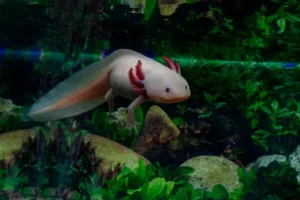
How Fast Do Axolotls Regenerate? Timeline and Facts

Axolotl regeneration is one of nature’s most incredible abilities. When you see videos of axolotls regrowing entire limbs, you might wonder how long this process actually takes. The answer depends on what body part is regenerating and the axolotl’s age, but the speed is still remarkably fast compared to any other vertebrate animal.
The Quick Answer
Axolotls regenerate limbs in 40-50 days on average. The process starts within hours of injury, with a wound cap forming in the first 24 hours. Visible regrowth begins around day 7-10, and a fully functional limb typically returns within 6-8 weeks. Younger axolotls regenerate faster than adults, sometimes completing the process in just 3-4 weeks. Other body parts like gills, tail, and organs regenerate at different speeds.
Limb Regeneration Timeline
Week 1: The Foundation
Hours 1-24: Wound healing
- Blood clots immediately at the injury site
- Skin cells migrate to cover the wound
- A protective cap forms over the amputation site
- No visible regrowth yet, just healing
Days 2-7: Blastema formation
- Cells at the wound site dedifferentiate (become less specialized)
- A bump called a blastema appears
- This is the growth zone where regeneration happens
- Looks like a small, pale bulge at the amputation site
Weeks 2-3: Early Growth
Days 8-14: Visible regrowth
- The blastema enlarges noticeably
- Basic limb shape begins forming
- Still looks like a cone or paddle, not a complete limb
- Growth is visible day-to-day if you watch closely
Days 15-21: Structure emerges
- Individual toes or fingers start separating
- The limb elongates significantly
- Basic bone structure begins developing inside
- Movement may be limited but present
Weeks 4-6: Maturation
Days 22-35: Functional development
- Limb reaches near-full size
- All toes/fingers are distinct and separating
- Muscle tissue develops and strengthens
- The axolotl begins using the limb cautiously
Days 36-50: Final touches
- Full pigmentation returns
- Muscle strength reaches normal levels
- Bone fully hardens
- Limb becomes indistinguishable from the original
By day 50, most adult axolotls have a completely regenerated, fully functional limb.
Factors That Affect Speed
Age Makes a Huge Difference
Baby axolotls (0-6 months):
- Regenerate limbs in 3-4 weeks
- Growth happens almost visibly fast
- High metabolism speeds everything up
- Near-perfect regeneration every time
Juvenile axolotls (6-18 months):
- Regenerate limbs in 4-6 weeks
- Still quite fast with excellent results
- Most consistent regeneration quality
Adult axolotls (18 months – 5 years):
- Regenerate limbs in 6-8 weeks
- Standard regeneration timeline
- Reliable but slower than young animals
Senior axolotls (8+ years):
- Regenerate limbs in 8-12 weeks or longer
- Slower process overall
- Quality may decrease slightly with age
- Still impressive for any animal
Water Quality Is Critical
Perfect water conditions speed regeneration:
Ideal parameters (60-64°F, 0 ammonia/nitrites):
- Fastest possible regeneration
- Minimal infection risk
- Clean, efficient healing
Acceptable parameters (65-68°F, trace toxins):
- Slightly slower regeneration
- Higher stress levels delay healing
- Still manageable
Poor parameters (high ammonia, warm water):
- Dramatically slowed regeneration
- Infection risk increases
- May stall completely until water improves
- Can take 2-3x longer than normal
Nutrition Matters
Well-fed axolotls regenerate faster:
Excellent diet (earthworms, varied foods):
- All necessary building blocks available
- Fast, healthy tissue growth
- Strong, functional regenerated parts
Poor diet (infrequent feeding, low-quality food):
- Slower regeneration due to nutrient deficiencies
- Weaker regenerated tissue
- May result in smaller or deformed regrowth
Injury Severity
The extent of damage affects timeline:
Clean amputation (toe or finger):
- 2-4 weeks for complete regeneration
- Fastest recovery type
Partial limb loss (mid-limb):
- 5-7 weeks average
- Standard regeneration process
Complete limb loss (shoulder/hip level):
- 8-10 weeks or more
- More tissue to regenerate takes longer
Multiple injuries:
- Body prioritizes resources
- Each injury may take longer than if alone
Other Body Parts Regeneration Speed
Gills (7-14 Days)
Gill filament damage repairs remarkably fast:
Minor damage: 5-7 days for full recovery Moderate damage: 10-14 days for complete regrowth Severe damage: 2-3 weeks for extensive regeneration
Gills are essential for breathing, so the body prioritizes their repair. You’ll notice improvement within 2-3 days of conditions improving.
Tail (6-8 Weeks)
Tail regeneration follows a similar timeline to limbs:
Tip damage: 2-3 weeks Partial tail loss: 4-6 weeks Significant tail loss: 6-10 weeks
The tail regenerates from the tip backward, gradually extending the length until it reaches the original size.
Organs (Varies Widely)
Internal organ regeneration happens at different speeds:
Heart tissue: Can regenerate in 2-3 months after damage Brain tissue: Regenerates but timeline varies (weeks to months) Spinal cord: 6-8 weeks for functional recovery Eyes: Partial regeneration over 4-6 weeks Jaw: 6-10 weeks depending on extent
Skin (1-3 Days)
Surface injuries heal fastest:
Minor scrapes: 24-48 hours Deeper wounds: 3-5 days Large skin loss: 1-2 weeks
Skin regeneration happens so fast you might not even notice the injury by the time you realize something happened.
What Regeneration Looks Like
Visual Progression
Watching regeneration happen is fascinating:
Day 1: Wound site, may bleed slightly, then clots
Day 3: Healing complete, wound cap formed
Day 7: Small bump (blastema) visible
Day 14: Obvious cone-shaped growth
Day 21: Paddle shape with toe buds
Day 30: Recognizable limb with separated toes
Day 40: Nearly full-sized, gaining pigment
Day 50: Complete, functional, normal appearance
The most dramatic changes happen between days 14-30 when the limb rapidly takes shape.
Color Changes
Pigmentation returns gradually:
Early stages: Regrowth is pale, almost translucent
Mid-stages: Light coloring appears but doesn’t match the body
Late stages: Color deepens to match surrounding tissue
Completion: Indistinguishable from original coloring
Sometimes the regenerated part remains slightly lighter or darker permanently, but usually color matches perfectly.
Can Regeneration Be Sped Up?
What Helps
You can’t force faster regeneration, but you can optimize conditions:
Perfect water quality is the single most important factor. Test daily during regeneration periods.
Cool temperature (60-64°F) provides ideal conditions. Warmer water slows healing.
High-quality food supplies building blocks. Feed earthworms and varied proteins.
Stress reduction helps the body focus energy on healing. Minimize handling, bright lights, and tank changes.
Adequate space prevents re-injury during the vulnerable healing period.
Gentle filtration maintains clean water without creating strong currents that stress the healing axolotl.
What Doesn’t Help
Avoid these common mistakes:
Supplements and vitamins: No evidence they speed regeneration and may harm water quality
Salt baths: Not necessary for regeneration and can stress the axolotl
Excessive handling: Checking progress daily by touching slows healing
Overfeeding: Won’t speed regeneration and pollutes water
“Healing additives”: Most are unproven and unnecessary
The axolotl’s body knows how to regenerate. Your job is simply providing optimal conditions and leaving it alone.
How Many Times Can They Regenerate?
No Known Limit
Axolotls can regenerate the same body part multiple times throughout their life:
Laboratory records: Some research axolotls have regenerated the same limb 5+ times with no decline in quality
No “regeneration budget”: Unlike some animals that can only regenerate once or twice, axolotls show no limits
Consistent quality: Each regeneration produces a functional, normal limb regardless of how many times it’s been done before
Lifelong ability: Even senior axolotls retain regeneration capability, though it slows with age
This unlimited regeneration makes axolotls unique among vertebrates.
Simultaneous Regeneration
Axolotls can regenerate multiple body parts at once:
Multiple limbs: Can regrow 2, 3, or even all 4 limbs simultaneously Different structures: Can regenerate limbs and tail and gills at the same time Resource allocation: Body spreads resources across all injuries, so each may take slightly longer than if regenerating alone Priority system: Essential structures like gills may receive priority over limbs
Common Regeneration Questions
Does regeneration hurt the axolotl?
Scientists believe they feel minimal pain during regeneration. The initial injury causes stress, but the healing process itself doesn’t appear painful.
Can regenerated limbs be injured again?
Yes, regenerated limbs are just as strong and functional as originals. They can be injured and will regenerate again if needed.
Will the regenerated part look identical?
Usually yes, but occasionally slight differences in size, color, or toe arrangement occur. These variations are minor and don’t affect function.
Can axolotls regenerate half a brain?
Yes, they can regenerate portions of brain tissue and restore function. This is being studied for potential human medical applications.
Do they regenerate faster in warmer water?
No, actually the opposite. Cool water (60-64°F) produces faster, cleaner regeneration. Warm water slows the process and increases infection risk.
What if regeneration seems stuck?
Check water parameters immediately. Stalled regeneration almost always indicates water quality problems. Once conditions improve, regeneration usually resumes.
Can you see bones growing back?
Not directly, but you can feel the limb firm up as cartilage and bone develop inside. The limb goes from soft and floppy to solid and strong over weeks 3-5.
Should I separate an injured axolotl from tank mates?
Yes, other axolotls may bite at the regenerating limb. Keep the injured one alone until regeneration completes.
Administrator
Abdul Wasay is the founder and lead author of Axolotl Portal, a trusted site for axolotl care. He spent almost nine months learning about axolotls, including their tanks, feeding, water care, and common health problems. His knowledge comes from trusted vets, research, and real experience from long term axolotl owners. All Posts by