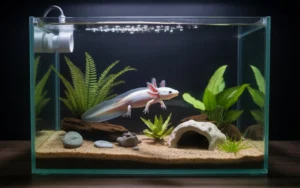
How Big of a Tank Does an Axolotl Need? The Size Reality Check

The pet store employee just told you a 10-gallon tank works fine for an axolotl. Your friend keeps theirs in a 15-gallon. But online forums say 20 gallons minimum, and some people insist on 40 gallons.
Who’s right? And why does everyone give different answers?
Let’s figure out what your axolotl actually needs not just what it can survive in.

The “Minimum” vs “Ideal” Problem
This is where all the confusion starts. People use “minimum” to mean different things.
Bare survival minimum: The smallest space where an axolotl won’t immediately die.
Responsible minimum: The smallest space where an axolotl can live a decent life without constant stress.
Ideal size: The tank size where an axolotl truly thrives with room to move and explore.
When someone says “10 gallons works,” they usually mean bare survival. When someone says “20 gallons minimum,” they mean responsible care. When someone recommends 40 gallons, they’re talking ideal.
The Actual Numbers
Here’s the breakdown based on axolotl size and number.
For One Adult Axolotl
Absolute minimum: 20 gallons (long tank, not tall)
Better: 30 gallons
Ideal: 40+ gallons
Why 20 gallons is the floor:
An adult axolotl reaches 9-12 inches long. In a 10-gallon tank, they can barely turn around. Imagine living in a closet where you can’t fully stretch out that’s what 10 gallons feels like to them.
A 20-gallon long tank provides enough floor space for basic movement. They can swim short distances, turn around comfortably, and have a few different areas to hang out in.
But 20 gallons is tight. It’s workable, but not generous.
For Two Adult Axolotls
Minimum: 40 gallons
Better: 50-55 gallons
Ideal: 75+ gallons
The math: Add 20 gallons per additional axolotl. Two axolotls don’t just need double the space they need territory.
Even if your axolotls get along fine, they benefit from having separate areas. One might want to hide while the other explores. One might be hungry while the other isn’t. Space prevents conflicts.
For Three or More
Minimum: 60 gallons for three
Add 20 gallons for each additional axolotl
Reality check: Most people shouldn’t keep three or more axolotls together. The larger the group, the more likely you’ll see aggression, nipped gills, or stress behaviors.
If you’re determined to keep multiple axolotls, bigger is always better.
For Juveniles
Under 3 months: Can start in 10 gallons temporarily
3-6 months: Move to 20 gallons minimum
6+ months: Adult-sized tank (20+ gallons)
Why juveniles get smaller tanks initially:
Baby axolotls are terrible hunters. In huge tanks, they struggle to find food. A smaller space (with excellent water quality) helps them catch prey efficiently.
But this is temporary. By 3-4 months, move them to adult-sized tanks. They grow fast.
Why Tank Shape Matters More Than Volume
A 20-gallon tall tank is NOT the same as a 20-gallon long tank for axolotls.
Tank dimensions matter:
20-gallon long: 30″ x 12″ x 12″ (length x width x height)
20-gallon tall: 24″ x 12″ x 16″
Why long beats tall:
Axolotls are bottom-dwellers. They walk along the tank floor more than they swim in the water column. Floor space (length x width) matters way more than height.
The 20-long gives 360 square inches of floor space. The 20-tall only gives 288 square inches despite the same water volume.
Always choose long/regular tanks over tall tanks.
The Filter and Water Quality Factor
Tank size directly impacts how stable your water stays.
Small Tanks = Unstable Water
In a 10-gallon tank, ammonia from waste builds up fast. One missed water change, one extra feeding, one big poop suddenly your water parameters crash.
The problem:
- Ammonia spikes happen within hours
- Temperature fluctuates more easily
- Less water volume means less margin for error
- You’re fighting to maintain stability constantly
Larger Tanks = Stable Water
A 40-gallon tank has 4x the water volume. Waste dilutes more effectively. Temperature stays consistent. Parameters remain stable between water changes.
The benefit:
- Slower ammonia buildup
- More forgiving if you miss a water change day
- Easier to maintain proper temperature
- Less stressful for both you and the axolotl
This is why experienced keepers recommend bigger tanks. Not because axolotls need space to exercise (though they do), but because larger water volume equals easier maintenance and better conditions.
The Swimming Behavior Reality
Let’s address a common argument: “My axolotl barely moves, so it doesn’t need a big tank.”
Why this thinking is wrong:
Axolotls in too-small tanks don’t move much because there’s nowhere to go. That’s not natural behavior that’s learned helplessness.
In properly sized tanks, axolotls:
- Patrol their territory regularly
- Swim laps (especially at night)
- Investigate new areas
- Display normal hunting behaviors
- Show personality differences
The comparison:
Put a dog in a small kennel 24/7. It stops moving much because there’s no point. That doesn’t mean the dog doesn’t need space it means the dog gave up trying to move.
Axolotls are the same. Limited movement in small tanks is a stress response, not proof they don’t need room.
What Happens in Too-Small Tanks
Besides water quality issues, cramped tanks create specific problems.
Stunted growth: Axolotls in undersized tanks often don’t reach full size. They stay smaller than genetics would normally allow.
Increased aggression: Multiple axolotls in tight spaces fight more. Nipped gills, bitten limbs, and stress are common.
Behavioral problems: Constant glass surfing (swimming up and down the walls), hiding 24/7, or complete inactivity signal stress.
Health issues: Chronic stress weakens immune systems. Sick axolotls in small tanks are harder to treat because water quality is already marginal.
Shortened lifespan: Axolotls that live 10-15 years in proper setups often die at 5-7 years in inadequate housing.
The “But My Axolotl Seems Fine” Argument
Pet store employees and some owners insist small tanks work because their axolotl hasn’t died yet.
The reality:
Axolotls are tough. They tolerate poor conditions longer than many animals. “Surviving” isn’t the same as “thriving.”
Signs your axolotl is just surviving:
- Rarely moves except at feeding time
- Hides constantly
- Never explores the tank
- Gills often curled forward
- Doesn’t reach expected adult size
- Frequent health issues
Signs your axolotl is actually thriving:
- Swims around regularly, especially at night
- Investigates decorations and changes
- Healthy, full gills
- Reaches 9-12 inches as an adult
- Active and responsive
- Rarely gets sick
Your axolotl won’t complain about a small tank. It’ll just quietly live a stressed, limited life. You’re responsible for providing better.
The Cost Reality
Let’s talk about the budget concerns that drive people toward smaller tanks.
Initial cost comparison:
- 10-gallon tank kit: $30-40
- 20-gallon long tank: $25-35 (tank only)
- 40-gallon breeder tank: $50-70 (tank only)
The surprise: Bigger tanks often cost less per gallon. A 40-gallon tank isn’t 4x more expensive than a 10-gallon.
Equipment costs stay similar:
Whether you run a 20-gallon or 40-gallon tank, you need:
- Filter (maybe slightly bigger)
- Heater or chiller
- Decorations
- Water testing kit
- Food
The equipment difference is maybe $20-30 more for a larger tank.
Long-term costs are actually lower:
Larger tanks need fewer water changes, use fewer water conditioners, and have fewer emergency issues. You spend less time and money fixing problems.
The math:
Spending an extra $30-50 upfront for a proper tank saves money on medication, vet visits, and replacements when your stunted axolotl dies young.
Special Situations
Some scenarios change the basic rules.
Hospital/Quarantine Tanks
Temporary housing for sick or injured axolotls can be smaller. A 10-gallon tank works for a few weeks while treating illness.
Why this is different:
You’re providing intensive care with daily water changes. The axolotl isn’t living there permanently. Once healed, it returns to the main tank.
Grow-Out Tanks for Babies
Breeders often use smaller tanks (5-10 gallons) for very young axolotls (under 6-8 weeks).
The key: Pristine water quality with daily water changes and low stocking density. As soon as babies are big enough, they move to larger housing.
Outdoor Ponds
Some people keep axolotls in outdoor ponds (in appropriate climates). Size calculations are different.
For ponds: 50+ gallons minimum, with consideration for temperature control, predator protection, and seasonal changes.
Making Your Decision
Here’s how to choose the right size for your situation.
If budget is tight:
Get one axolotl in a 20-gallon long tank. This is the responsible minimum. Skip the 10-gallon it’s not worth the stress and problems.
Save up for equipment gradually. The tank is the priority.
If you want multiple axolotls:
Wait until you can afford a 40+ gallon setup. Don’t cram multiple axolotls into a 20-gallon hoping it works.
If you’re upgrading from too-small:
Your axolotl will noticeably improve in a bigger tank. Increased activity, better appetite, and healthier appearance happen within weeks.
If you’re not sure:
Go bigger than you think you need. You won’t regret having extra space. You will regret going too small.
The Bottom Line
Single adult axolotl: 20-gallon long minimum, 30-40 gallons better
Two adult axolotls: 40 gallons minimum, 50-75 gallons better
Three or more: Add 20 gallons per additional axolotl
Tank shape: Long tanks, not tall tanks
Why it matters: Water quality, swimming space, natural behavior, and long-term health
The honest truth:
If you can’t afford or don’t have space for a 20-gallon long tank minimum, you’re not ready for an axolotl.
These animals live 10-15 years. Keeping them in inadequate housing for a decade isn’t fair to them and creates constant problems for you.
Buy the right size tank from the start. Your axolotl deserves it, and you’ll have a healthier, happier pet that’s easier to care for.
The extra 10-20 gallons of water isn’t just space it’s the difference between surviving and thriving.
Administrator
Abdul Wasay is the founder and lead author of Axolotl Portal, a trusted site for axolotl care. He spent almost nine months learning about axolotls, including their tanks, feeding, water care, and common health problems. His knowledge comes from trusted vets, research, and real experience from long term axolotl owners. All Posts by
Related Guides
How to Acclimate a New Axolotl to Your Tank: A Complete Guide
Abdul Wasay Khatri
What is the Ideal pH for Axolotls? Everything You Need to Know
Abdul Wasay Khatri
How to Test Water Parameters for Axolotls: A Practical Guide
Abdul Wasay Khatri
Can Axolotls Live in a 20 Gallon Tank?
Abdul Wasay Khatri
Can Axolotls Live in a 10 Gallon Tank?
Abdul Wasay Khatri
Complete Axolotl Tank Setup Guide: Size, Equipment & Care (2026)
Abdul Wasay Khatri