
Do Axolotls Have Scales? The Skin Truth

Your axolotl’s skin looks smooth and soft when you watch it swim. But up close, you notice what might be tiny bumps or texture. Are those scales? Should they have scales?
You’ve heard they’re salamanders (which are amphibians), but they live in water like fish (which have scales). So which is it?
Do Axolotls Have Scales?
| Feature | Axolotls | Fish (Comparison) |
|---|---|---|
| Scales | ❌ No | ✅ Yes |
| Skin type | Smooth, soft, permeable skin | Scaly, protective skin |
| Classification | Amphibian | Fish |
| Breathing | Gills + skin | Gills only |
| Water sensitivity | Very high | Moderate |
| Handling safety | Easily injured | More durable |
The Direct Answer
No, axolotls do not have scales.
They have completely smooth, scaleless skin like all amphibians.
What you’re seeing isn’t scales it’s something else entirely. We’ll explain what you’re actually looking at and why the confusion happens so often.

Why Everyone Gets Confused
The scale confusion makes total sense when you think about where axolotls live and what they look like.
They Live Like Fish
Axolotls spend their entire life underwater. Fish have scales. So your brain assumes “aquatic animal = scales.”
The logic seems solid:
- Lives in water permanently ✓
- Has fins (the tail fin) ✓
- Swims constantly ✓
- Must have scales… ✗
But being aquatic doesn’t automatically mean scales. Plenty of water-dwelling animals lack scales.
The Texture You’re Seeing
Look closely at your axolotl’s skin and you’ll notice:
- Small bumps or dots
- Slight texture, not perfectly smooth
- Variations in color intensity
- What might look like tiny raised areas
What you’re actually seeing:
Mucus glands: Those bumps are glands that produce slime coating. Every amphibian has these.
Pigment cells: Color variations come from different types of pigment cells (melanophores, xanthophores, iridophores) visible through the skin.
Natural skin texture: Amphibian skin has texture from cell patterns, not from scales.
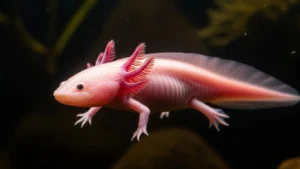
Blood vessels: Especially visible in light-colored morphs like leucistic (pink) ones.
None of these are scales. They’re normal parts of amphibian skin structure.
Pet Store Confusion
Many pet stores keep axolotls in the fish section. You see them next to goldfish, bettas, and other scaled fish. The placement creates an unconscious association.
Staff who primarily know fish might even accidentally say axolotls have scales because they’re thinking in “fish terms.”
What Axolotl Skin Actually Is
Understanding amphibian skin explains why it’s nothing like fish scales.
Permeable and Absorbent
Axolotl skin is permeable meaning substances pass through it easily in both directions.
What passes through:
- Oxygen from water (they breathe partly through skin)
- Water molecules
- Dissolved chemicals
- Medications
- Toxins and pollutants
Why this matters:
This is why water quality is SO critical for axolotls. They’re absorbing whatever’s in the water directly through their skin.
A fish with scales has a protective barrier. An axolotl doesn’t. Think of their skin as a sponge constantly soaking up their environment.
The Slime Coat
Instead of scales for protection, axolotls produce a mucus coating.
What the slime does:
- Creates a barrier against bacteria
- Helps regulate water and salt balance
- Reduces friction when swimming
- Provides some protection against minor abrasions
You can see this slime:
When you (carefully, with wet hands) touch an axolotl, your fingers feel slimy afterward. That’s the protective mucus coat doing its job.
Never scrub or damage this coat. If you remove the slime layer, you’ve stripped away their protection and made them vulnerable to infection.
Multiple Layers
Axolotl skin has several layers, but none of them are scales.
Outer layer (epidermis):
- Very thin
- Contains mucus glands
- Constantly shedding and regenerating
- No protective armor
Middle layer (dermis):
- Contains pigment cells
- Blood vessels
- Connective tissue
- Provides structure
Inner layers:
- Muscle and fat tissue
- No hard protective structures
The key difference from fish:
Fish have scales made of bone or keratin hard, protective plates overlapping like armor. Axolotl skin has none of this. It’s soft tissue through and through.
Fish Scales vs Axolotl Skin Comparison
Let’s see exactly how different these are.
| Feature | Fish Scales | Axolotl Skin |
|---|---|---|
| Material | Bone or keratin (hard) | Soft tissue only |
| Structure | Overlapping plates | Smooth continuous surface |
| Protection | Physical armor | Mucus coating only |
| Permeability | Mostly waterproof barrier | Highly permeable |
| Breathing through it | No | Yes (30% of oxygen) |
| Regeneration | Scales regrow individually | Entire skin regenerates as one unit |
| Sensitivity | Less sensitive (protected) | Extremely sensitive |
| Can you see them clearly | Yes, obvious plates | No visible structures |
The bottom line: These are completely different types of skin serving different purposes.
What About Shed Skin?
Axolotls regularly shed their skin, which adds to the confusion.
How Shedding Works
Every 1-2 weeks, axolotls shed their outer skin layer.
What you’ll see:
- Axolotl looks slightly cloudy or dull
- They might rub against decorations
- Suddenly, a thin transparent sheet comes off
- Often they eat it immediately (this is normal)
- Skin looks bright and fresh afterward
What people think:
Some owners see the shed skin and think “scales are coming off!”
What’s actually happening:
The entire outer layer sheds as one piece or in large sheets. This is how all amphibians shed completely different from fish losing individual scales.
Why They Shed
Shedding serves multiple purposes:
Removes parasites and bacteria that might be clinging to the outer layer
Gets rid of damaged skin from minor injuries or wear
Allows growth in young axolotls
Refreshes the mucus coat with a clean slate
Normal frequency: Once every week or two for adults, more often for juveniles
When Shedding Looks Wrong
Normal shedding:
- Comes off in large sheets or the whole skin at once
- Happens relatively quickly (within an hour)
- Axolotl looks fine afterward
- Happens regularly without distress
Problem shedding:
- Skin coming off in small pieces constantly
- Axolotl looks stressed or uncomfortable
- Raw, red patches visible underneath
- Excessive rubbing against objects
- Happens too frequently (multiple times per week)
Abnormal shedding usually means:
- Poor water quality irritating the skin
- Infection or fungal problem
- Ammonia burns
- Water temperature wrong
Reptile Comparison (Another Confusion Source)
Some people confuse axolotls with aquatic reptiles that DO have scales.
Animals with scales:
- Turtles (reptiles)
- Lizards (reptiles)
- Snakes (reptiles)
- Fish (not reptiles, but scaled)
Animals without scales:
- Axolotls (amphibians)
- Frogs (amphibians)
- Salamanders (amphibians)
- All amphibians lack scales
Why the confusion:
Aquatic turtles live in water like axolotls. But turtles are reptiles with scales and shells. Axolotls are amphibians with soft, permeable skin.
The fact that both live in water tanks doesn’t make them biologically similar.
The Evolutionary Reason
Understanding evolution explains why axolotls don’t have scales.
Amphibian Heritage
Axolotls are salamanders, and salamanders evolved from ancient amphibians that first moved onto land.
The amphibian strategy:
Instead of developing armor (scales), amphibians kept highly permeable skin that allows:
- Cutaneous respiration (breathing through skin)
- Water and salt regulation through skin
- Sensory input from water chemistry
This strategy worked for amphibians living in moist environments or returning to water.
Why Fish Kept Scales
Fish never left water. They evolved scales for:
- Protection from predators
- Reducing water loss in certain environments
- Streamlining for fast swimming
- Physical armor against injuries
Different evolutionary pressures = different solutions
Why Axolotls Specifically Don’t Need Them
Axolotls evolved in calm lake environments with:
- Few large predators
- Muddy bottoms (camouflage worked better than armor)
- Plenty of hiding spots in vegetation
They survived by:
- Staying hidden during the day
- Being active at night
- Regenerating injuries rather than preventing them
- Using camouflage coloring
Scales would have been extra weight and metabolic cost without adding survival value in their specific habitat.
Touch and Handling: Why Skin Type Matters
The fact that axolotls lack scales directly affects how you should handle them.
They’re Extremely Delicate
Without scales for protection, axolotl skin damages easily.
What hurts them:
- Dry hands touching them (absorbs moisture from their skin)
- Rough handling
- Scraping against tank decorations with sharp edges
- Contact with soap or chemical residue on your hands
- Catching them in nets (the mesh abrades skin)
The Right Way to Handle (When Necessary)
Wet your hands first: Completely soak your hands in tank water. Never touch with dry hands.
Support, don’t grab: Cup your hands underneath and let them rest on your palms. Don’t squeeze or grip.
Keep handling minimal: Only touch them when absolutely necessary (tank maintenance, health checks).
Use the bucket method: For moving them, scoop into a container rather than touching directly.
Never use nets: Nets designed for fish are too rough for scaleless amphibian skin.
Why Fish Handling Tools Don’t Work
Fish can be netted because scales protect them from abrasion. The same net tears an axolotl’s delicate skin.
Fish can be handled with dry hands briefly. Doing this to an axolotl strips their slime coat and damages skin cells.
The tools that work:
- Soft container or cup to scoop them up
- Your own hands (wet and clean)
- Smooth plastic containers for transport
Signs of Skin Damage
Without scales as armor, you need to watch for skin problems.
Healthy skin looks:
- Smooth and evenly colored
- Slightly slimy to touch (if you must touch)
- Full, fluffy gills (skin health affects gills)
- No white patches, red areas, or fuzzy spots
Damaged skin shows:
- White or gray patches (fungus)
- Red inflamed areas (bacterial infection or injury)
- Fuzzy cotton-like growth (fungal infection)
- Raw or bleeding spots (physical damage)
- Excessive slime production (irritation response)
What causes skin damage:
- Poor water quality (most common cause)
- Physical injuries from sharp decorations
- Aggressive tank mates
- Handling with dry or soapy hands
- Chemical exposure (soaps, lotions, cleaners)
The Silver Lining of Scaleless Skin
Not having scales actually gives axolotls a superpower.
Incredible Regeneration
Axolotl skin heals and regenerates at remarkable speed.
What they can regenerate:
- Minor wounds close within days
- Skin rips or tears heal completely
- Even deep injuries eventually regenerate
- Lost limbs regrow with perfect skin coverage
- Damaged gills regrow
Why scaleless skin helps:
The simple, permeable skin structure regenerates more easily than complex scaled skin. Fish can’t regrow missing scales as perfectly as axolotls regrow skin.
The trade-off:
Less protection, but better repair. Axolotls evolved to heal damage rather than prevent it.
The Bottom Line
Do axolotls have scales? No. Zero scales. None.
What they have instead: Soft, permeable amphibian skin covered in protective mucus
Why no scales: They’re amphibians (salamanders), not fish or reptiles. Amphibians never developed scales.
What looks like scales: Mucus glands, pigment cells, and natural skin texture not scales
Why it matters for care:
- Water quality must be perfect (skin absorbs everything)
- Handling must be minimal and careful
- Sharp decorations must be avoided
- Chemical exposure is extremely dangerous
The key takeaway:
If you’re caring for an axolotl like it’s a fish with protective scales, you’re doing it wrong. Treat the skin as the delicate, permeable organ it is.
That smooth, scaleless skin is part of what makes them amphibians and part of why they need such specific care. No scales means no armor, which means you’re responsible for keeping their environment safe enough that they don’t need armor.
Understanding what axolotl skin really is and isn’t helps you provide better care and avoid damage to this vulnerable, remarkable organ.
Administrator
Abdul Wasay is the founder and lead author of Axolotl Portal, a trusted site for axolotl care. He spent almost nine months learning about axolotls, including their tanks, feeding, water care, and common health problems. His knowledge comes from trusted vets, research, and real experience from long term axolotl owners. All Posts by
Related Guides
Male vs Female Axolotl: Which Is Better? The Complete Comparison
Abdul Wasay Khatri
Axolotl vs Salamander: What’s the Real Difference?
Abdul Wasay Khatri
Can Two Axolotls Live Together Safely?
Abdul Wasay Khatri
What Human Food Can Axolotls Eat? Safe Foods and What to Avoid
Abdul Wasay Khatri
What Are Good Axolotl Names? 100+ Ideas That Actually Fit These Weird Little Creatures
Abdul Wasay Khatri

Can You Have an Axolotl as a Pet? The Honest Truth from Real Owners
Abdul Wasay Khatri
Are All Axolotls Girls? Gender Facts Explained
Abdul Wasay Khatri
What Is the Cutest Axolotl Color? Every Color Ranked
Abdul Wasay Khatri
Can Axolotls Survive Outside Water? The Critical Facts You Need to Know
Abdul Wasay Khatri
What Do Axolotls Eat? Complete Feeding Guide (2026 Update)
Abdul Wasay Khatri