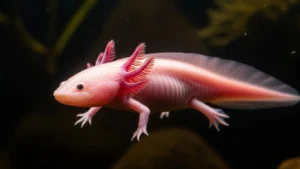
Do Axolotls Have Good Eyesight? Understanding Their Vision

I remember hand-feeding my first axolotl and noticing she’d miss the worm completely, snapping at empty water beside it. After five years observing these salamanders daily, I’ve learned their vision is far more limited than most people expect. Let me explain what axolotls can actually see.
The Straightforward Answer
No, axolotls don’t have good eyesight. Their vision is quite poor compared to most animals. They can detect movement, light changes, and basic shapes, but they can’t see fine details or focus well on objects. They rely more heavily on other senses for hunting and navigation.
This doesn’t mean they’re blind just that vision plays a supporting role rather than being their primary sense.
How Axolotl Eyes Function
Axolotl eyes are small, dark, and positioned on the sides of their head. This placement gives them a wide field of view but poor depth perception.
No eyelids mean their eyes stay exposed constantly. Without the ability to blink, they can’t clean or protect their eyes the way mammals do. This makes them vulnerable to injury and debris.
Fixed lens prevents focusing. Most animals adjust their eye lenses to focus on near or far objects. Axolotl lenses don’t move or change shape, leaving them with blurry vision at most distances.
Limited color perception means they probably see mostly in grayscale or muted tones. Research suggests their color vision is minimal at best.
Poor resolution prevents seeing details. What looks sharp to us appears fuzzy to axolotls. They see general outlines rather than crisp images.
I’ve tested this countless times during feeding. An axolotl will strike at a worm from six inches away and miss by an inch or more. Only when food comes very close do they target accurately.
What Axolotls Can See
Despite poor eyesight, axolotls do gather useful visual information:
Movement detection works reasonably well. They notice when something moves in their field of view, triggering hunting instincts. A wiggling worm catches attention even if details remain unclear.
Light and dark changes register clearly. Axolotls react to sudden lighting changes, preferring dim conditions. Bright lights cause visible stress and avoidance behavior.
Large shapes and silhouettes are recognizable. They can distinguish between a human hand approaching versus a piece of decoration. The outline registers even if features don’t.
Distance approximation happens within close range. At 2-3 inches, they judge distance well enough to strike at food. Beyond that, accuracy drops dramatically.
Contrast differences help them navigate. Dark objects against light backgrounds or vice versa stand out more than subtle color variations.
My axolotls definitely recognize me versus strangers approaching the tank, though this probably combines visual cues with vibration detection and learned patterns.
Primary Senses Axolotls Use Instead
Since vision is limited, axolotls depend on other senses for survival:
Lateral line system is their superpower. This network of pressure-sensitive cells along their body detects water movement, vibrations, and pressure changes. It’s how they find food in complete darkness.
Smell plays a huge role in feeding. Axolotls have excellent chemical detection. They smell food in the water and follow the scent trail. I’ve watched blind axolotls hunt successfully using smell alone.
Touch receptors across their skin provide environmental information. They feel surfaces, water flow, and contact with objects.
Taste helps them identify food once it touches their mouth. They’ll spit out inappropriate items after tasting them.
During feeding time, I’ve observed that axolotls respond to food scent before they visually locate it. They’ll turn toward the food source and search using their lateral line, with vision only helping at the final strike moment.
Vision Differences Between Color Morphs
Different axolotl color varieties have slightly varying vision capabilities:
Leucistic and albino axolotls have the poorest vision. Their eyes lack protective pigmentation, making them extra sensitive to light. Bright lighting hurts them, and they struggle more than darker morphs.
Wild type and melanoid varieties have pigmented eyes offering some protection. Their vision is still poor but slightly better than albinos. They tolerate somewhat brighter conditions.
Eye color correlates with light sensitivity. Red or pink eyes (albinos) are most vulnerable. Dark eyes handle varied lighting marginally better.
I keep my albino axolotls in especially dim conditions compared to my wild types. The difference in their comfort level is noticeable.
How Poor Vision Affects Behavior
Limited eyesight shapes how axolotls interact with their environment:
Feeding responses are slow and often inaccurate. They need multiple strikes to catch food. Using feeding tongs to place food directly in front of them works better than dropping food randomly.
Tank navigation relies more on memory and touch than sight. Axolotls learn tank layouts through exploration, not visual mapping.
Social interaction between tank mates involves proximity detection rather than visual recognition. They bump into each other regularly because they don’t see clearly enough to avoid collisions.
Stress from lighting is common. Bright aquarium lights that look attractive to humans cause significant discomfort for axolotls with poor light-adapted vision.
Hiding behavior stems partly from light sensitivity. They seek dark areas where their limited vision isn’t overwhelmed by brightness.
Feeding Strategies for Poor Vision
Understanding their limited sight helps me feed them effectively:
Direct placement using long feeding tongs puts food right at their nose. This eliminates the need for visual hunting.
Wiggling food creates movement that attracts attention even with blurry vision. I move earthworms slightly to trigger strikes.
Feeding in dim light reduces stress during mealtimes. I turn off bright lights before feeding.
One axolotl at a time when possible ensures each gets adequate food. With poor vision, they can’t compete effectively with tank mates during group feeding.
Patience is essential. I wait while they locate food through smell and lateral line detection. Rushing the process leads to missed meals.
Tank Setup Considerations
Their poor vision influences proper habitat design:
Low lighting creates comfortable conditions. I use minimal ambient room light rather than bright aquarium lights.
High contrast decorations help with navigation. Dark rocks on light substrate or vice versa provides visual cues.
Consistent layout lets them memorize locations. Frequent rearranging confuses them since they can’t easily see new arrangements.
Smooth surfaces prevent eye injuries. Sharp decorations they can’t see clearly pose collision risks.
No bright-colored gravel prevents confusion. Since they can’t see well, they might mistake colorful substrate for food.
Vision Problems and Health Issues
Sometimes vision gets even worse due to health problems:
Cloudy eyes indicate bacterial or fungal infections. The eye appears milky or hazy instead of clear black.
Swollen eyes suggest injury, infection, or poor water quality. The eye bulges outward abnormally.
Missing eyes can result from aggressive tank mates, though axolotls surprisingly adapt well to complete blindness.
Cataracts occasionally develop in elderly axolotls, further reducing already limited vision.
I’ve had an axolotl lose an eye to an injury. She adapted within days, relying entirely on other senses with no noticeable hunting difficulties.
Comparing to Other Aquatic Animals
Axolotl vision is poor even compared to other underwater creatures:
Fish generally have much better vision with focusing ability and often color perception.
Turtles see quite well both underwater and on land, with good detail recognition.
Frogs have excellent vision, especially for movement, essential for their hunting style.
Newts see better than axolotls, likely because some species need vision for terrestrial life stages.
Axolotls rank among the poorest-sighted aquatic animals commonly kept as pets.
Why Evolution Gave Them Poor Vision
Their weak eyesight makes evolutionary sense given their natural habitat and hunting style:
Dark lake bottoms in their native Mexican habitat provide little light. Good vision isn’t necessary in near-darkness.
Ambush predators don’t need sharp vision. They wait for prey to come close rather than actively chasing it.
Excellent lateral line provides better hunting information than vision could in murky water.
Neoteny means they retain larval features, including relatively undeveloped eyes compared to metamorphosed salamanders.
Their survival strategy simply doesn’t require good vision, so evolution didn’t prioritize developing it.
Practical Tips for Owners
Knowing about their poor eyesight changes care routines:
- Approach the tank slowly to avoid startling them
- Feed directly rather than scattering food
- Keep lighting dim and indirect
- Maintain consistent tank layouts
- Use smell and movement to attract attention during feeding
- Don’t expect them to recognize you visually they learn patterns and vibrations instead
Final Thoughts
Do axolotls have good eyesight? No, their vision is notably poor. They see blurry shapes, detect movement, and respond to light changes, but fine details escape them completely.
After five years observing these animals, I appreciate how well they compensate using other senses. Their lateral line system and sense of smell make excellent vision unnecessary for their lifestyle.
Understanding their visual limitations helps provide better care. Feed thoughtfully, light carefully, and appreciate that their sensory world differs dramatically from ours.
Frequently Asked Questions
Q: Can axolotls see in the dark?
Not really. They have no special night vision abilities. However, their lateral line system works excellently in complete darkness, letting them hunt successfully without any light.
Q: Do axolotls recognize their owners?
They learn patterns and likely associate certain vibrations or silhouettes with feeding time, but this isn’t true visual recognition like a dog recognizes faces. It’s learned behavioral response to familiar stimuli.
Q: Why do axolotls have eyes if they don’t see well?
Evolution hasn’t removed eyes because they provide some useful information about light, movement, and basic shapes. Poor vision is better than no vision, even if other senses dominate.
Q: Can axolotls live normally if they go blind?
Yes, absolutely. Blind axolotls adapt quickly and hunt successfully using their lateral line system and sense of smell. Vision loss doesn’t significantly impact their quality of life.
Q: Should I keep my axolotl tank in complete darkness?
Not necessary. Dim ambient light is fine. Complete darkness isn’t needed since they navigate primarily through non-visual senses anyway. Just avoid bright, direct lighting that causes stress.
Q: Do albino axolotls see worse than dark-colored ones?
Slightly, yes. Albino eyes lack protective pigmentation, making them more light-sensitive and potentially affecting vision clarity. Both have poor vision overall, but albinos struggle more with bright conditions.
Administrator
Abdul Wasay is the founder and lead author of Axolotl Portal, a trusted site for axolotl care. He spent almost nine months learning about axolotls, including their tanks, feeding, water care, and common health problems. His knowledge comes from trusted vets, research, and real experience from long term axolotl owners. All Posts by
Related Guides
Axolotl Morphing Signs: What to Watch For
Abdul Wasay Khatri
Do Axolotls Have Eyes? Everything You Need To Know About Axolotl Vision
Abdul Wasay Khatri
Do Axolotls Have Lungs? The Surprising Truth About Their Breathing
Abdul Wasay Khatri
What Powers Do Axolotls Have? Understanding Their Real Biological Abilities
Abdul Wasay Khatri
Are Axolotls Actually Immortal? Separating Myth from Reality
Abdul Wasay Khatri
Can Axolotls Change Color? The Complete Truth About Color Shifts
Abdul Wasay Khatri
What Body Parts Can Axolotls Regenerate?
Abdul Wasay Khatri
Are Axolotls Born With Legs? Development Stages Explained
Abdul Wasay Khatri
How Many Chromosomes Do Axolotls Have? Complete Genetics Guide
Abdul Wasay Khatri
Do Axolotls Breathe Air? The Breathing Truth Explained
Abdul Wasay Khatri