Do Axolotls Have Ears? Understanding How Axolotls Hear Sounds

You tap on the glass, and your axolotl doesn’t react. You call their name nothing. Drop something heavy near the tank, and suddenly they dart away. This creates a puzzling question: can axolotls actually hear, or are they completely deaf?
The answer isn’t simple. Axolotls experience sound in ways completely different from what we’re used to, and understanding how requires rethinking what “hearing” really means.

Do Axolotls Have Ears?
Yes and no this is where the confusion starts.
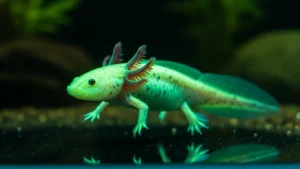
Axolotls do NOT have external ears. They lack ear holes, ear flaps, or any visible ear structures on the outside of their body. If you look closely at an axolotl’s head, you won’t find anything that looks like an ear.
However, axolotls DO have internal ear structures hidden beneath their skin and skull. These inner ears contain the same basic components found in other vertebrates: chambers filled with fluid, tiny bones, and sensory cells that detect vibrations.
The key difference is that their ears are completely internal with no opening to the outside world. Sound reaches these inner ears through their skull bones and body tissues rather than through an ear canal like mammals have.
This makes “Do axolotls have ears?” a trick question. They have the internal equipment for detecting sound, but none of the external structures we associate with ears.
Can Axolotls Actually Hear?
Yes, axolotls can detect sounds, but calling it “hearing” in the traditional sense is misleading.
Axolotls perceive sound through vibrations rather than airborne sound waves. Think of it as feeling sound through their entire body rather than hearing it through ears.
How axolotl sound detection works:
Sound creates vibrations in water. Water conducts vibrations much better than air about four times faster and more efficiently.
These vibrations travel through the water and hit the axolotl’s body.
The vibrations pass through their skin, tissues, and bones, reaching the inner ear structures.
The inner ear detects these vibrations and sends signals to the brain.
The axolotl’s brain interprets these signals as environmental information something moved, something splashed, something is approaching.
This process differs significantly from how mammals hear. We funnel sound waves through external ears into ear canals. Axolotls detect vibrations throughout their entire body simultaneously.

What Sounds Can Axolotls Detect?
Axolotls don’t hear the way you might hope. They can’t recognize their name, enjoy music, or respond to your voice calling them.
What they CAN detect:
Heavy vibrations: Footsteps near the tank, objects dropping on furniture, doors slamming. These create strong vibrations that travel through the floor and into the water.
Water disturbances: Splashing, filter flow changes, other animals moving in the tank. These create direct water vibrations they sense easily.
Low-frequency sounds: Deep, rumbling noises below 100 Hz. These frequencies travel well through water and create strong vibrations.
Substrate vibrations: Movement on or near the tank bottom. They’re particularly sensitive to vibrations through surfaces they’re touching.
Large movements nearby: Even without sound, pressure waves from movement in water alert them to approaching objects or animals.
What they CANNOT detect well:
High-frequency sounds: Human voices, music, most everyday noises. These frequencies don’t create strong enough vibrations in water for axolotls to sense.
Airborne sounds: Talking, TV noise, conversations in the room. These sounds travel through air and don’t transfer efficiently into water.
Quiet sounds: Gentle movements, soft music, whispered voices. The vibrations are too weak to register.
Direction of sound: While they know something happened, pinpointing exactly where the sound came from is difficult for them.
Complex sounds: They can’t distinguish between different types of sounds or understand patterns like music or speech.
The Lateral Line System: Their Real Superpower
Here’s what most people don’t realize: axolotls rely much more on their lateral line system than their inner ears.
The lateral line is a sensory system that runs along both sides of the axolotl’s body. It consists of tiny sensory organs called neuromasts that detect water movement and vibrations.
How the lateral line works:
Small pores along the axolotl’s body connect to sensory cells beneath the skin.
These cells have tiny hair-like structures called cilia that bend when water moves past them.
When vibrations pass through water, the cilia detect these changes and send signals to the brain.
The brain creates a detailed map of water movement around the axolotl’s entire body.
What the lateral line detects:
Prey movement: Small fish or worms moving nearby create water disturbances the lateral line picks up instantly.
Water flow: Changes in current patterns help them navigate and understand their environment.
Nearby objects: They can “feel” tank walls, decorations, and other objects through water displacement even in complete darkness.
Other axolotls: The movements of tank mates create vibration patterns they sense and respond to.
Predator approach: Anything large moving toward them creates pressure waves they detect before physical contact.
The lateral line essentially gives axolotls a “touch at a distance” sense. They feel their surroundings through water without needing to physically touch anything.
This system is far more important to axolotls than their rudimentary hearing. In their natural dark, murky lake environment, seeing and hearing were less useful than sensing vibrations and water movement.
Why Axolotls Seem Deaf Sometimes
Understanding their sensory limitations explains why they often appear completely deaf to sounds that seem obvious to us.
Your axolotl ignores you calling their name because:
Human voices create high-frequency sounds that don’t vibrate water strongly enough for them to detect.
Even if they could detect your voice, they have no concept of names or language. They can’t learn to associate sounds with meaning the way dogs do.
The sound waves from your voice travel through air, hit the glass, and mostly bounce back rather than transferring into the water.
Why they don’t react to music or TV:
Most music frequencies fall outside their detection range. They might sense heavy bass notes but not melodies or rhythms.
Even if they could detect it, they have no emotional or cognitive response to music. It’s just meaningless vibration to them.
The sounds come through air and glass, which dramatically reduces vibration transfer into their water environment.
Why tapping the tank sometimes gets a reaction (but shouldn’t):
Tapping creates direct vibrations in the glass and water that they CAN feel through their lateral line.
However, repeated tapping stresses them. The sudden vibration feels like a predator strike or environmental danger.
Just because they respond doesn’t mean you should do it. The response is fear/stress, not recognition or curiosity.
Why they react to footsteps but not voices:
Heavy footsteps create floor vibrations that travel into the tank stand and eventually the water.
These low-frequency vibrations are exactly in their detection range.
The vibrations come from below, which triggers their instinct to notice ground-based disturbances.
Testing Axolotl Hearing: What Works and What Doesn’t
Many owners try to test whether their axolotl can hear. Most common tests give misleading results.
Tests that DON’T work:
Calling their name: They can’t hear most voice frequencies and don’t understand names anyway.
Playing music: Unless it’s extremely bass-heavy, they won’t detect it, and even if they do, they won’t care.
Clapping or snapping: These high-frequency sounds don’t transfer well into water.
Whispering or talking near the tank: Air-to-water sound transfer is too inefficient.
Tests that MIGHT show results (but stress them):
Tapping tank glass: Creates vibrations they detect, but causes stress. Not recommended.
Dropping heavy objects near tank: The floor vibrations reach them, but this is frightening and stressful.
Creating loud bass sounds: Deep frequencies might register, but still stressful and unnecessary.
Tests that actually work (and are less stressful):
Observing their reaction to normal household activities: Do they respond to footsteps at certain times of day?
Watching during feeding: Many learn to associate vibrations (your approach) with food, though this isn’t hearing.
Noting reactions to filter changes: Changes in water flow patterns (detected via lateral line) often cause responses.
Monitoring during water changes: The change in water movement and pressure affects them noticeably.
The truth is, testing whether they can “hear” misses the point. They sense their environment through vibrations and water movement, which is neither hearing nor touch but something in between.
How This Affects Daily Care
Understanding axolotl sensory perception changes how you should interact with them.
Move slowly around their tank:
Sudden movements create strong vibrations and pressure waves that startle them.
Approach calmly and let them sense your presence gradually through subtle vibrations.
Darting movements trigger their prey or predator response, causing stress.
Avoid tapping or hitting the tank:
What seems like a gentle tap to you feels like a shock wave through their entire body.
The vibration overwhelms their sensory systems and causes genuine fear.
Repeated tapping can lead to chronic stress and health problems.
Be aware of tank placement:
Tanks on wobbly stands or near high-traffic areas expose axolotls to constant vibrations.
Placement near speakers, washing machines, or heavy doors creates stressful vibration patterns.
A stable location with minimal floor vibrations is ideal.
Consider household activity patterns:
If your axolotl always hides when you’re home but explores at night, they’re likely reacting to increased daytime vibrations.
Families with children or pets create more vibration than quiet households, affecting axolotl behavior.
Use vibrations intentionally (but carefully):
Some owners train axolotls to associate specific vibrations with feeding time.
Gently touching the same spot on the tank before feeding can create a predictable pattern they learn.
This uses their natural sensory abilities without causing stress.
Understand their startle response:
When they dart away suddenly, they detected a vibration that seemed threatening.
This isn’t “bad behavior” it’s a survival instinct responding to their sensory input.
Reducing unexpected vibrations helps them stay calmer.
Comparing Axolotl Senses
To understand where hearing fits in their sensory world, let’s compare all their senses.
Vision: Moderate but limited
Axolotls can see, but their vision is poor compared to most animals. They’re nearsighted and see best in dim light. Vision helps them detect movement and general shapes but not fine details.
Smell: Excellent
Their sense of smell is highly developed. They detect food through water-borne scent molecules from impressive distances. This is their primary food-finding sense.
Taste: Good
Taste receptors throughout their mouth help them identify food once they grab it. They’ll spit out things that taste wrong.
Touch: Excellent
Their entire body is touch-sensitive. The skin detects temperature changes, water chemistry shifts, and physical contact immediately.
Lateral line: Excellent
This sense of water vibrations and movement is one of their strongest. It works constantly to map their environment.
Hearing: Poor
Their ability to detect sound vibrations ranks as one of their weakest senses. It provides basic environmental awareness but little detailed information.
Ranking their senses by importance:
- Smell (finding food)
- Lateral line (navigating, detecting threats and prey)
- Touch (environmental information)
- Vision (basic awareness)
- Taste (food identification)
- Hearing (minimal function)
This ranking explains why they seem “deaf” they rely on hearing so little that its absence barely affects them.
The Evolutionary Explanation
Why did axolotls evolve such poor hearing compared to other animals? Their environment provides the answer.
Their native habitat:
Axolotls originally lived in Lake Xochimilco and Lake Chalco in Mexico. These lakes had murky, dark water full of sediment and plant matter.
In this environment:
- Vision didn’t work well due to poor visibility
- Airborne sound was irrelevant since they never left water
- High-frequency underwater sounds got absorbed by sediment
- Low-frequency vibrations traveled well through the water and lake bottom
Evolutionary pressure:
Animals evolve senses that help them survive in their specific environment. Axolotls needed to:
- Find small prey in dark, murky water (smell and lateral line)
- Avoid predators they couldn’t see (vibration detection)
- Navigate without visual references (lateral line and touch)
- Locate mates in low visibility (smell)
None of these survival needs required good hearing. Vibration detection through the lateral line and keen smell served them much better.
Energy efficiency:
Maintaining complex sensory organs requires energy. If a sense doesn’t improve survival, evolution doesn’t waste resources developing it.
Axolotls invested biological resources in smell and lateral line development rather than hearing because these senses provided better survival advantages.
Neoteny’s role:
Axolotls retain juvenile characteristics their entire life. Larval salamanders typically have less-developed hearing than adults. By staying in larval form, axolotls never developed the more advanced hearing some adult salamanders possess.
This wasn’t a disadvantage their aquatic lifestyle made advanced hearing unnecessary.
Other Aquatic Animals’ Hearing
Comparing axolotls to other water-dwelling creatures shows how varied aquatic hearing can be.
Fish:
Many fish hear quite well despite lacking external ears. They use their swim bladder as a resonating chamber that amplifies vibrations.
Some species hear frequencies from 50 Hz to 3,000 Hz much broader than axolotls.
Fish that hunt actively or live in complex environments often have better hearing.
Frogs and toads:
Adult frogs have well-developed hearing with external eardrums (tympanic membranes) visible on their head.
They hear frequencies from 100 Hz to 5,000 Hz, allowing them to recognize species-specific mating calls.
Their hearing is crucial for reproduction and survival in ways axolotl hearing is not.
Aquatic mammals (dolphins, whales):
These animals have exceptional underwater hearing, detecting frequencies from 20 Hz to over 100,000 Hz.
They use echolocation and communicate through complex sounds, making hearing their primary sense.
They evolved from land mammals, so their hearing developed for different purposes than axolotl hearing.
Sea turtles:
Turtles hear frequencies from about 100 Hz to 1,000 Hz underwater better than axolotls but not exceptional.
Like axolotls, they rely more on vision and other senses for most activities.
Comparison conclusion:
Axolotls rank near the bottom of aquatic animals for hearing ability. They’re functional but not specialized for auditory perception like many other water-dwelling creatures.
Frequently Asked Questions
Can my axolotl recognize my voice?
No, axolotls cannot recognize voices. They lack the hearing range to detect most human vocal frequencies clearly, and they don’t have the cognitive ability to associate specific sounds with individuals or meanings.
Do axolotls react to their name?
Axolotls don’t respond to names. If your axolotl seems to “come when called,” they’re actually responding to vibrations from your approach, visual cues, or the smell of food not the sound of their name.
Should I play music for my axolotl?
Music doesn’t benefit axolotls. They can’t appreciate it and barely detect most frequencies. If the music has heavy bass, it might create vibrations that stress them rather than entertain them.
Why does my axolotl hide when I vacuum?
Vacuums create strong floor vibrations that axolotls detect easily. These sudden, intense vibrations signal danger, triggering their instinct to hide. This is a sensible survival response, not fear of the sound itself.
Can axolotls hear underwater better than above water?
This question doesn’t quite work for axolotls since they’re always underwater. However, water conducts vibrations better than air, so sounds transfer more effectively through their aquatic environment than through air.
Do baby axolotls hear better than adults?
No significant difference exists between juvenile and adult hearing. Their sensory systems are similar throughout their life since they don’t undergo metamorphosis that would change their sensory organs.
Will loud noises hurt my axolotl’s ears?
Very loud, low-frequency vibrations could potentially stress or disorient axolotls, but they’re unlikely to suffer hearing damage the way mammals might. Their bigger risk is stress from repeated intense vibrations.
Can axolotls go deaf?
Technically yes, if their inner ear structures were damaged, but this is extremely rare and difficult to diagnose since they rely so little on hearing anyway. Changes in behavior would more likely indicate other health problems.
Why do people say axolotls are deaf if they have inner ears?
It’s an oversimplification. They have basic hearing structures but such limited hearing ability that calling them “deaf” is easier than explaining their complex vibration-detection system.
Do axolotls communicate through sounds?
No, axolotls don’t produce sounds to communicate with each other. They may create incidental noises while moving or eating, but they don’t vocalize or use sound for social interaction.
Can I train my axolotl using sound?
Not effectively. Any “training” based on sound actually relies on vibrations, visual cues, or smell associations. You could train them using consistent vibration patterns, but audible sounds won’t work.
Is my axolotl scared of thunderstorms?
If your axolotl acts stressed during storms, they’re responding to barometric pressure changes, vibrations from thunder, or changes in electromagnetic fields not the sound of thunder. These environmental shifts affect many aquatic animals.
Making Peace With Their Limited Hearing
Many new owners feel disappointed learning their axolotl can’t hear them. This emotional response is natural but misplaced.
Why the “deafness” doesn’t matter:
Your axolotl never expected to hear you. They evolved without needing this sense.
They experience their world richly through smell, touch, lateral line detection, and basic vision.
Not hearing doesn’t reduce their quality of life they don’t know what they’re missing.
Their sensory world is different from ours, not inferior to ours.
What you can do instead of talking to them:
Create consistent routines they learn through repeated experiences and vibration patterns.
Allow them to smell your hand (in the water with clean, wet hands) so they learn your scent.
Move slowly and predictably so they feel safe through their lateral line detection.
Provide enrichment that stimulates their actual senses different textures, hiding spots, and foods.
Appreciating their real abilities:
Instead of wishing they could hear, marvel at how they navigate perfectly in complete darkness using water vibrations.
Watch how they instantly detect and locate food through smell alone.
Observe how they sense your approach before you’re even visible through the tank glass.
Recognize that their sensory world is fascinating precisely because it’s so different from yours.
Building a real connection:
Bonding with an axolotl doesn’t require them hearing you. It comes from:
- Providing excellent care that keeps them healthy and comfortable
- Learning to read their body language and behavior
- Creating an environment that suits their actual sensory needs
- Respecting their nature instead of expecting them to be like mammals
Many owners report strong bonds with their axolotls despite the communication barriers. These relationships are based on routine, trust, and observation rather than verbal interaction.
The Bottom Line
Axolotls have internal ear structures but lack external ears or ear openings. They can detect vibrations, especially low-frequency ones, but calling this “hearing” overstates their ability. They perceive sound as vibration through their entire body rather than processing it as auditory information.
Their lateral line system provides much more detailed environmental information than their rudimentary hearing. This system detects water movement and vibrations with impressive accuracy, making their “deafness” irrelevant to their daily life.
They cannot hear human voices, music, or most common household sounds. They respond to heavy vibrations like footsteps or door slams, but this is vibration detection rather than hearing.
Understanding their actual sensory abilities helps you provide better care and set realistic expectations. Don’t tap on the tank trying to get their attention it only stresses them. Instead, work with their natural senses by moving slowly, maintaining routines, and creating an environment that suits their vibration-detecting, smell-oriented sensory world.
Your axolotl doesn’t need to hear you to thrive. They experience a rich sensory life completely different from yours, and appreciating this difference is part of the joy of keeping these fascinating creatures.
Administrator
Abdul Wasay is the founder and lead author of Axolotl Portal, a trusted site for axolotl care. He spent almost nine months learning about axolotls, including their tanks, feeding, water care, and common health problems. His knowledge comes from trusted vets, research, and real experience from long term axolotl owners. All Posts by
Related Guides
Do Axolotls Breathe Air? The Breathing Truth Explained
Abdul Wasay Khatri
Can Axolotls Regrow Their Brain or Internal Organs?
Abdul Wasay Khatri
Can Axolotls Become Salamanders? The Truth About Metamorphosis
Abdul Wasay Khatri
How Many Chromosomes Do Axolotls Have? Complete Genetics Guide
Abdul Wasay Khatri
Will My Axolotl’s Gills Grow Back After Damage?
Abdul Wasay Khatri
Can Axolotls Feel Pain? Understanding Their Sensory Experience
Abdul Wasay Khatri
Do Axolotls Have Lungs? The Surprising Truth About Their Breathing
Abdul Wasay Khatri
What Makes Axolotls Unique Among Amphibians? The Extraordinary Salamander
Abdul Wasay Khatri
Are Axolotls Born With Legs? Development Stages Explained
Abdul Wasay Khatri
What Powers Do Axolotls Have? Understanding Their Real Biological Abilities
Abdul Wasay Khatri